


-5%
 Baby Mom
 Diabetic Care
 Health Devices
 Medicines
 Personal Care
 Sexual Wellbeing
 Vital Wellness
 Vitamins Supplements
 Women Care
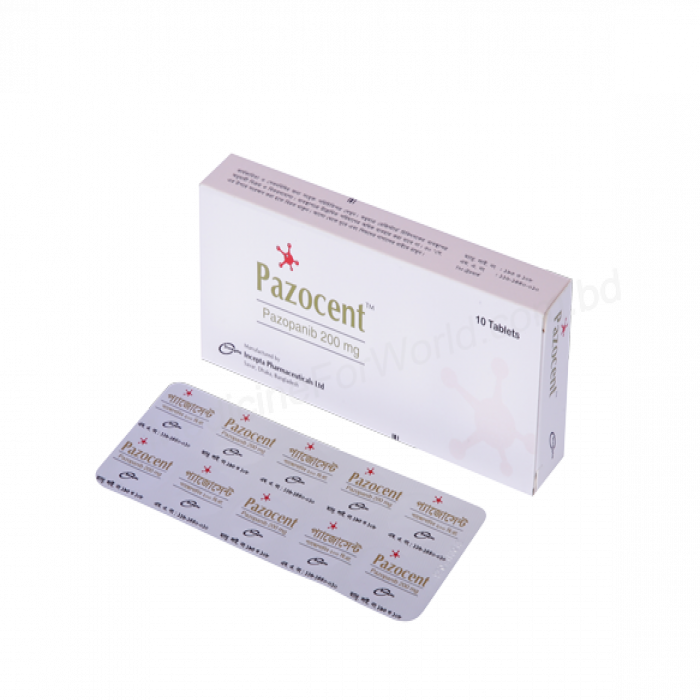
Manufacturer: Incepta Pharmaceuticals Ltd.
Generic: Pazopanib
Type: Tablet
Pack Size: 10 Pcs

Hurry and get discounts on all Apple devices up to 20%
Sale_coupon_15
2,500.00৳ Original price was: 2,500.00৳ .2,375.00৳ Current price is: 2,375.00৳ .
Pazocent is indicated for the treatment of:
Pazopanib is a multi-tyrosine kinase inhibitor targeting various receptors, including:
Absorption
Pazopanib is absorbed orally, reaching peak concentration in 2 to 4 hours. When administered at 800 mg daily, the geometric mean AUC (Area Under the Curve) is 1,037 mcg/mL and C max is 58.1 mcg/mL.
Distribution
Pazopanib binds to plasma proteins in humans with an in vivo binding of greater than 99%, unaffected by concentration over the range of 10 to 100 mcg/mL.
Metabolism
Pazopanib is metabolized primarily by CYP3A4, with some contributions from CYP1A2 and CYP2C8.
Elimination
The drug has a half-life of 30.9 hours after an 800 mg dose. The majority is eliminated via feces, with less than 4% excreted renally.
Baby Mom
Diabetic Care
Health Devices
Medicines
Personal Care
Sexual Wellbeing
Vital Wellness
Vitamins Supplements
Women Care