


-5%
 Baby Mom
 Diabetic Care
 Health Devices
 Medicines
 Personal Care
 Sexual Wellbeing
 Vital Wellness
 Vitamins Supplements
 Women Care
Manufacturer: Ibne Sina Pharmaceuticals
Type: Tablet
Pack Size: 10 Pcs

Hurry and get discounts on all Apple devices up to 20%
Sale_coupon_15
600.00৳ Original price was: 600.00৳ .570.00৳ Current price is: 570.00৳ .
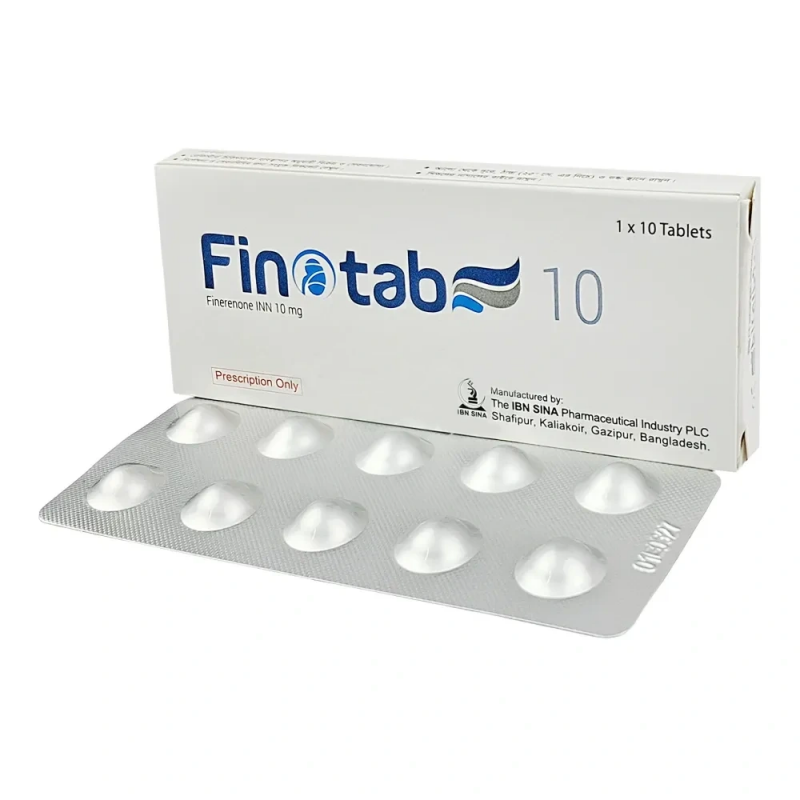
Finotab tablet is prescribed to lower the risk of persistent decline in estimated glomerular filtration rate (eGFR), progression to end-stage kidney disease, cardiovascular death, nonfatal myocardial infarction, and hospitalization due to heart failure in adults with chronic kidney disease (CKD) associated with type 2 diabetes (T2D).
Finerenone is a selective, nonsteroidal mineralocorticoid receptor (MR) antagonist. Aldosterone and cortisol activate MR receptors, which regulate gene transcription involved in sodium balance, inflammation, and fibrosis. By blocking these receptors, Finerenone reduces sodium retention and prevents excessive MR activation in the kidneys, heart, and blood vessels, helping reduce inflammation and tissue fibrosis.
The medicine has strong selectivity for mineralocorticoid receptors and minimal activity on androgen, estrogen, progesterone, or glucocorticoid receptors. Clinical studies showed modest reductions in blood pressure, with systolic pressure decreasing by about 3 mmHg and diastolic pressure by 1–2 mmHg. Even at doses four times higher than recommended, Finerenone did not produce clinically significant QT prolongation.
Finerenone is fully absorbed after oral administration, though its absolute bioavailability is approximately 44% due to metabolism. Peak plasma concentration is generally reached within 0.5 to 1.25 hours after dosing.
Finerenone is completely absorbed orally. Food intake does not significantly affect its overall absorption.
The steady-state volume of distribution is approximately 52.6 L. Around 92% of the drug binds to plasma proteins, mainly serum albumin.
The terminal half-life is about 2–3 hours, with systemic clearance around 25 L/hour.
Finerenone is mainly metabolized through CYP3A4 (about 90%) and partly through CYP2C8 (about 10%) into inactive metabolites. Roughly 80% of the administered dose is excreted through urine.
Baby Mom
Diabetic Care
Health Devices
Medicines
Personal Care
Sexual Wellbeing
Vital Wellness
Vitamins Supplements
Women Care