


-5%
 Baby Mom
 Diabetic Care
 Health Devices
 Medicines
 Personal Care
 Sexual Wellbeing
 Vital Wellness
 Vitamins Supplements
 Women Care

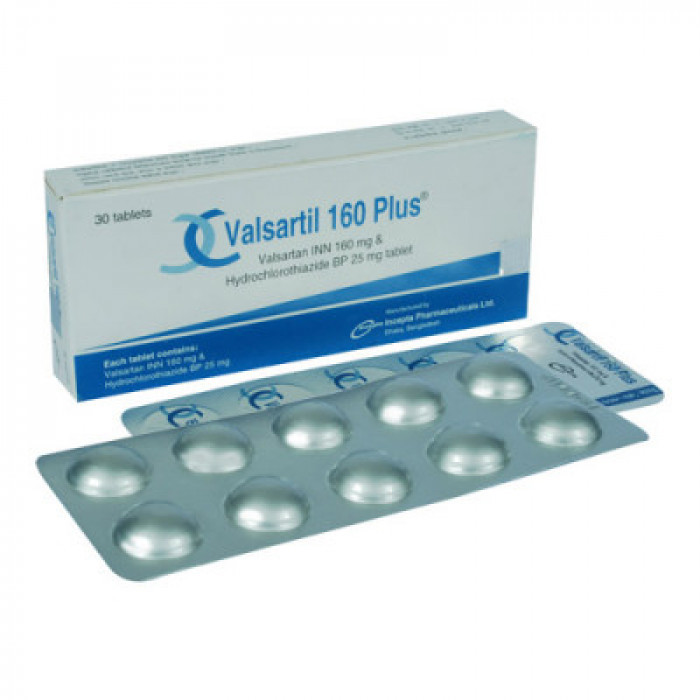
Manufacturer: Incepta Pharmaceuticals Ltd.
Generic: Valsartan + Hydrochlorothiazide
Type: Tablet
Pack Size: 10 Pcs

Hurry and get discounts on all Apple devices up to 20%
Sale_coupon_15
80.00৳ Original price was: 80.00৳ .76.00৳ Current price is: 76.00৳ .
Generic Name: Valsartan 160mg + Hydrochlorothiazide 25mg
Manufacturer: Incepta Pharmaceuticals Ltd.
Indications
A pair of medications are combined in Valsartil Plus 160/25. This combination is indicated for the treatment of hypertension.
Pharmacology
Angiotensin receptor blockers are a class of medications that include the oral pill valsartan (ARBs). It is a specific and dynamic angiotensin II antagonist that is working on the AT1 subtype orally. Vasoconstriction is a result of angiotensin’s interaction with the receptors, which causes the blood vessels to constrict, increasing blood volume (hypertension). Valsartan inhibits angiotensin II receptor activity. Valsartan widens blood arteries and reduces blood weight without altering heart rate by inhibiting the action of angiotensin. Valsartan has a substantially stronger preference (20,000 times stronger) for the AT1 receptor than the AT2 receptor. It does not bind to or fragment other hormone receptors or particle channels that are known to be crucial for controlling heart rate.
Hydrochlorothiazide is a kind of thiazide diuretic. Thiazides affect the electrolyte reabsorption mechanisms in the renal tubules, causing a nearly equal increase in salt and chloride excretion. The diuretic action of hydrochlorothiazide decreases plasma volume, which increases plasma renin activity, aldosterone secretion, urinary potassium loss, and serum potassium levels. Because renin-aldosterone communication is mediated by angiotensin II, co-administration of an ACE inhibitor tends to reverse the potassium loss brought on by these diuretics.
Dosage & Administration
Interaction
Contraindications
The combination of Valsartan and Hydrochlorothiazide is contraindicated in people who are hypersensitive to either component of this medication. Due to the Hydrochlorothiazide component, this drug is contraindicated in patients who have anuria or hypersensitivity to other medications derived from sulfonamides.
Side Effect
The Valsartan and Hydrochlorothiazide combination is generally well tolerated, with few adverse effects.
Pregnancy & Lactation
Precautions & Warnings
Storage Conditions
Store between 15-30° C.
Baby Mom
Diabetic Care
Health Devices
Medicines
Personal Care
Sexual Wellbeing
Vital Wellness
Vitamins Supplements
Women Care