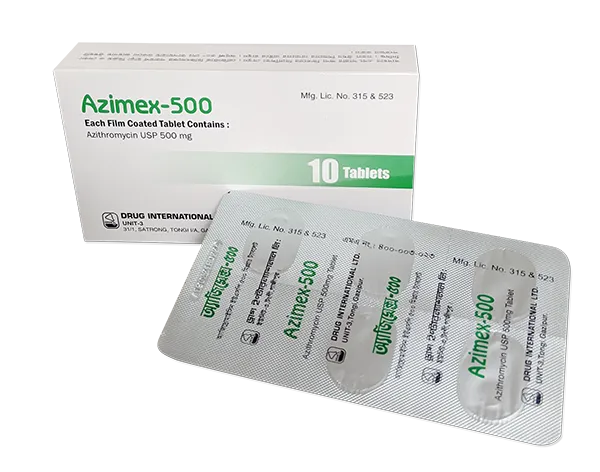
Azimex is indicated for the treatment of infections caused by susceptible microorganisms, including:
Lower respiratory tract infections such as bronchitis and community-acquired pneumonia
Upper respiratory tract infections, including sinusitis, pharyngitis, and tonsillitis
Acute otitis media
Skin and soft tissue infections
Sexually transmitted infections such as non-gonococcal urethritis and cervicitis caused by Chlamydia trachomatis
Azimex contains Azithromycin, an acid-stable macrolide antibiotic that can be administered orally without requiring protection from gastric acid. It is rapidly absorbed, with optimal absorption occurring when taken on an empty stomach. Peak blood concentrations are generally achieved within 2–3 hours after oral administration.
Azithromycin accumulates extensively inside phagocytic cells, allowing efficient transport to sites of infection. Drug concentrations within infected tissues may exceed plasma concentrations by more than 50-fold, contributing to prolonged antibacterial activity.
The drug has a long elimination half-life of approximately 68 hours, allowing once-daily dosing and sustained therapeutic concentrations in infected tissues for several days. Elimination occurs primarily through biliary excretion as an unchanged drug, while only a small proportion is eliminated via the kidneys.
Intravenous Administration (Adults Only)
Community-Acquired Pneumonia
500 mg IV once daily for at least 2 days, followed by 500 mg orally once daily to complete a total treatment duration of 7–10 days.
Pelvic Inflammatory Disease
500 mg IV once daily for 1–2 days, followed by 250 mg orally once daily to complete a 7-day course.
If anaerobic organisms are suspected, additional anaerobic antimicrobial coverage should be considered.
Safety and efficacy of injectable azithromycin have not been established in patients younger than 16 years.
Always follow your physician’s dosing instructions.
Preparation of Oral Suspension
Shake the bottle thoroughly to loosen the powder.
Add previously boiled and cooled water up to the marked fill line.
Shake vigorously until the suspension becomes uniform.
For best absorption, administer Azimex at least 1 hour before or 2 hours after meals.
Drug Interactions
Azimex may interact with several medications, including:
Antacids: Reduce absorption; administer Azimex at least 1 hour before or 2 hours after antacids.
Cyclosporine: Monitor blood concentrations and adjust dosage if necessary.
Digoxin: May increase digoxin levels; monitor carefully.
Ergot derivatives: Concomitant use is contraindicated because of the potential risk of ergot toxicity.
Theophylline: Although significant interaction is uncommon, monitoring is advisable.
Warfarin: Routine monitoring of prothrombin time is recommended.
Carbamazepine: No clinically significant interaction has been observed.
Methylprednisolone: No meaningful pharmacokinetic interaction has been reported.
Terfenadine: No significant effect on drug levels or QT interval has been demonstrated at recommended doses.
Contraindications
Azimex should not be used in patients with:
Known hypersensitivity to azithromycin or other macrolide antibiotics
Concurrent use of ergot derivatives
Active liver disease or significant hepatic impairment