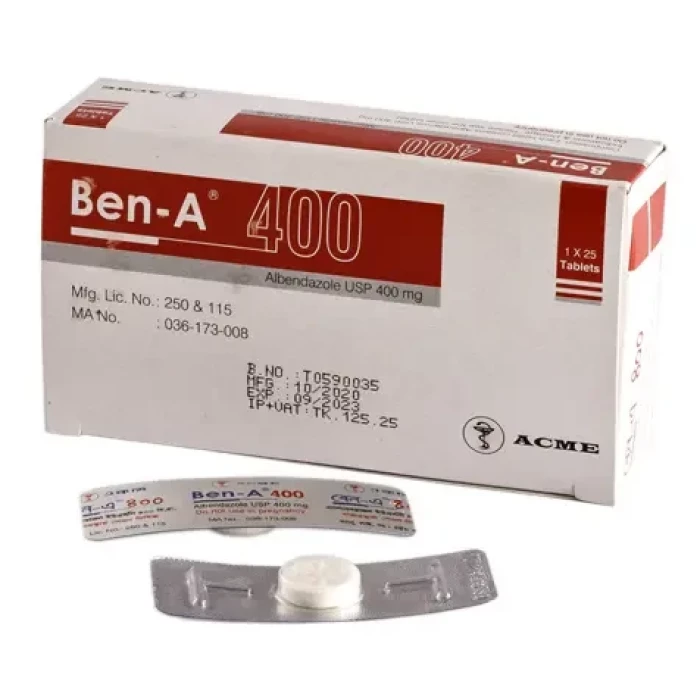
Ben-A is used for the treatment of single and mixed infestations, including:
- Hookworm (Ancylostoma, Necator)
- Roundworm (Ascaris lumbricoides)
- Threadworm (Enterobius vermicularis)
- Whipworm (Trichuris trichiura)
- Strongyloidiasis (Strongyloides stercoralis)
- Tapeworm infections
- Opisthorchiasis
- Hydatid disease (Echinococcosis)
Description:
Ben-A is a benzimidazole anthelmintic effective against various nematodes and some cestodes. It is primarily used for intestinal worm infections and higher doses are prescribed for hydatid disease.
- It has vermicide, ovicidal, and larvicidal properties.
- It works by inhibiting tubulin polymerization, leading to the disruption of cytoplasmic microtubules, which are essential for parasite survival.
Pharmacology:
Albendazole is a broad-spectrum anthelmintic with activity against worms at multiple stages of development.
- It works by blocking glucose uptake in parasites, causing energy depletion and eventual immobilization.
- The drug undergoes extensive metabolism in the liver and has a primary metabolite, albendazole sulphoxide, which has anthelmintic properties.
- The plasma half-life of albendazole sulphoxide is approximately 8.5 hours.
- It is poorly absorbed in the gastrointestinal tract and is primarily excreted in the urine.
Dosage & Administration:
For Adults & Children Over 2 Years:
- Single-dose treatment (for Enterobius, Trichuris, Ascaris, Ancylostoma, Necator): 400 mg (1 tablet or 10 ml suspension).
- For Strongyloidiasis or Taeniasis: 400 mg daily for 3 consecutive days. If not cured, a second course is recommended after 3 weeks.
- Children (1-2 years old): Single dose of 200 mg (5 ml suspension).
- Children under 1 year: Not recommended.
For Hydatid Disease (Echinococcosis):
- Adults over 60 kg: 400 mg twice daily for 28 days.
- Patients under 60 kg: 15 mg/kg daily in two divided doses (maximum daily dose: 800 mg).
- Cystic Echinococcosis: The 28-day course may be repeated after 14 days without treatment, for up to 3 cycles.
- Alveolar Echinococcosis: Treatment cycles (28 days on, 14 days off) may continue for months or years.
For Giardiasis:
- 400 mg once daily for 5 days.
Drug Interactions:
- No known pharmacodynamic or pharmacokinetic interactions have been reported.
Contraindications:
- Not recommended for neonates.
- Dose adjustment may be needed in children under 10 kg.
- Pregnancy: Should not be used in pregnant women or those suspected to be pregnant.
- Concurrent diseases: No need for dosage adjustment in renal, hepatic, or cardiac failure.
Side Effects:
- Gastrointestinal issues: Nausea, vomiting, abdominal pain.
- Neurological symptoms: Headache, dizziness.
- Liver function changes: Altered enzyme levels.
- Rare effects: Reversible hair loss, skin rash, fever, blood disorders (leucopenia, pancytopenia).
- Serious reactions: Allergic shock if cyst leakage occurs, convulsions in cerebral disease.
Pregnancy & Lactation:
- Pregnancy Category C (US FDA) – Should be avoided during pregnancy, unless the benefits outweigh the risks.
- Lactation: Use with caution.
Precautions & Warnings:
- Regular blood count and liver function tests are required before and during treatment cycles.
- Ensure pregnancy exclusion before starting treatment.
- Should be monitored under medical supervision for echinococcosis.
Therapeutic Class:
Storage Instructions:
- Store in a dry place, away from light and heat.
- Keep out of reach of children.
Ben A is prescribed to treat various parasitic worm infections, including:
- Hookworm
- Roundworm
- Threadworm
- Whipworm
- Tapeworm
- Strongyloidiasis
- Hydatid disease (Echinococcosis)
- Neurocysticercosis
How should I take Ben A?
- Take Ben A exactly as prescribed by your doctor.
- Swallow the tablet whole without crushing, chewing, or breaking it.
- It may be taken with or without food, but taking it at a fixed time daily is recommended.
What are the common side effects of Ben A?
Some common side effects include:
- Vomiting
- Dizziness
- Nausea
- Loss of appetite
- Increased liver enzyme levels
Can I take Ben A during pregnancy or breastfeeding?
- Pregnancy: Ben A should not be taken during pregnancy as it may harm the unborn baby. Use effective birth control while taking this medication.
- Breastfeeding: The effects on breast milk are unknown, so consult your doctor before use.
Do I need medical monitoring while taking Ben A?
Yes. Your doctor may monitor:
- Blood counts and liver function tests before and during treatment.
- Signs of infection, as the medication may weaken your immune response.
What should I avoid while taking Ben A?
- Avoid contact with sick or infected people.
- Do not skip doses or stop taking the medication early, even if you feel better.
- Women of childbearing age should only start treatment within 7 days of normal menstruation and use non-hormonal contraception during and one month after therapy.
How is Ben A dosed for different infections?
- Echinococcosis:
- <60 kg: 15 mg/kg/day in 2 divided doses (max: 800 mg/day).
- ≥60 kg: 400 mg twice daily for 28-day cycles, with 14-day drug-free intervals.
- Neurocysticercosis:
- <60 kg: 15 mg/kg/day in 2 divided doses (max: 800 mg/day) for 8-30 days.
- ≥60 kg: 400 mg twice daily for 8-30 days.
- Hookworm, Ascariasis, Trichostrongylus:
Does Ben A interact with other medications?
Yes, interactions may occur:
- Increased serum concentration: Dexamethasone, praziquantel, cimetidine.
- Decreased serum concentration: Antimalarials (aminoquinolines), carbamazepine, phenobarbital, phenytoin.
Who should avoid taking Ben A?
Ben A is contraindicated in:
- Pregnant women (unless benefits outweigh risks).
- Neonates (not recommended).
- Patients with liver impairment or hypersensitivity to Albendazole.
What are the serious or rare side effects of Ben A?
Rare but serious effects:
- Bone marrow suppression (low blood cell count)
- Liver problems (hepatitis, liver failure)
- Severe allergic reactions (rash, urticaria)
- Neurological effects (meningeal signs, increased intracranial pressure)
Potentially fatal effects:
- Aplastic anemia
- Acute liver and renal failure
- Pancytopenia (deficiency of all blood cells)
How should Ben A be stored?
- Store in a dry place, away from light and heat.
- Keep out of reach of children.



 Baby Mom
 Diabetic Care
 Health Devices
 Medicines
 Personal Care
 Sexual Wellbeing
 Vital Wellness
 Vitamins Supplements
 Women Care