


-5%
 Baby Mom
 Diabetic Care
 Health Devices
 Medicines
 Personal Care
 Sexual Wellbeing
 Vital Wellness
 Vitamins Supplements
 Women Care


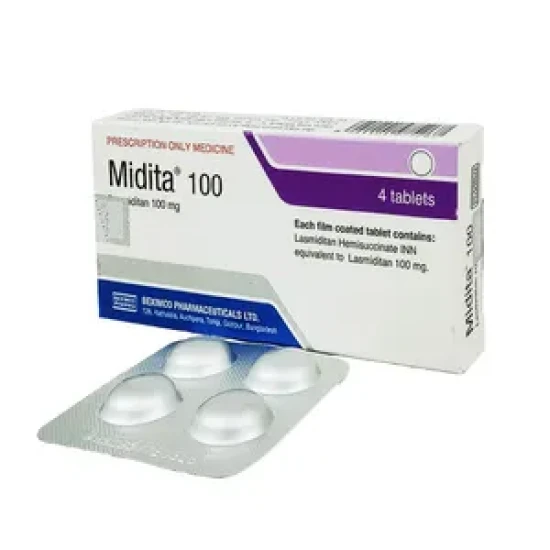
Manufacturer: Beximco Pharmaceuticals Ltd.
Type: Tablet
Pack Size: 4pcs

Hurry and get discounts on all Apple devices up to 20%
Sale_coupon_15
308.00৳ Original price was: 308.00৳ .292.60৳ Current price is: 292.60৳ .
Lasmiditan Hemisuccinate | A medication used for fast relief of migraine headaches.
Pediatric Use: Safety and effectiveness in children have not been established
Hepatic Impairment:
Mild to moderate impairment (Child-Pugh A or B): No dose adjustment required
Severe impairment (Child-Pugh C): Use is not recommended
Lasmiditan represents a novel class of acute anti-migraine therapy that works by modulating neuronal activity rather than causing cerebral vasoconstriction. This mechanism differentiates it from traditional migraine treatments such as triptans. Lasmiditan demonstrates a rapid onset of action, with some patients experiencing symptom relief as early as 20 minutes after administration, making it particularly valuable for acute migraine management.
Because Lasmiditan can cause central nervous system (CNS) effects, including dizziness and drowsiness, it may significantly impair activities that require mental alertness. Patients should therefore be advised to avoid driving or operating machinery for at least 8 hours after taking a dose.
Lasmiditan may also carry a potential risk for misuse, and caution is advised when prescribing it to individuals with a history of substance abuse. Its classification as a controlled substance is currently under evaluation by the U.S. Drug Enforcement Administration (DEA).
The safety of Lasmiditan during pregnancy has not been established. Ongoing monitoring is being conducted through a pregnancy exposure registry established by Eli Lilly and Company to evaluate potential risks to fetal development.
Historically, acute migraine treatment focused on constricting dilated cerebral blood vessels, based on the belief that vascular dilation was the primary cause of migraine pain. However, the neurogenic hypothesis of migraine proposes that abnormal activation of trigeminal nerve pathways plays a central role in migraine pathophysiology, with vasodilation occurring as a secondary effect.
Although the exact mechanism of action of Lasmiditan is not fully defined, it is believed to exert its therapeutic effect through selective and potent agonism of the 5-HT₁F (serotonin) receptor. These receptors are located in both the central and peripheral nervous systems, particularly on trigeminal neurons. Activation of 5-HT₁F receptors leads to hyperpolarization of nerve terminals and suppression of trigeminal neuronal firing, thereby reducing migraine-related pain signals without inducing vasoconstriction.
Previously, migraine pain was thought to result primarily from the dilation of cerebral blood vessels. However, the neurogenic theory of migraine suggests that abnormal activation of trigeminal nerve pathways is the main cause of migraine pain, while vasodilation is a secondary effect.
Although the exact mechanism of action of Lasmiditan is not fully understood, it is believed to work by selectively activating 5-HT (serotonin) receptors located in both the central and peripheral nervous system, particularly on trigeminal neurons. Activation of these receptors leads to hyperpolarization of nerve terminals and inhibition of trigeminal nerve firing, thereby reducing migraine pain.
Lasmiditan has minimal affinity for other serotonin receptor subtypes and does not significantly interact with adrenergic or dopaminergic receptors.
Baby Mom
Diabetic Care
Health Devices
Medicines
Personal Care
Sexual Wellbeing
Vital Wellness
Vitamins Supplements
Women Care