


-5%
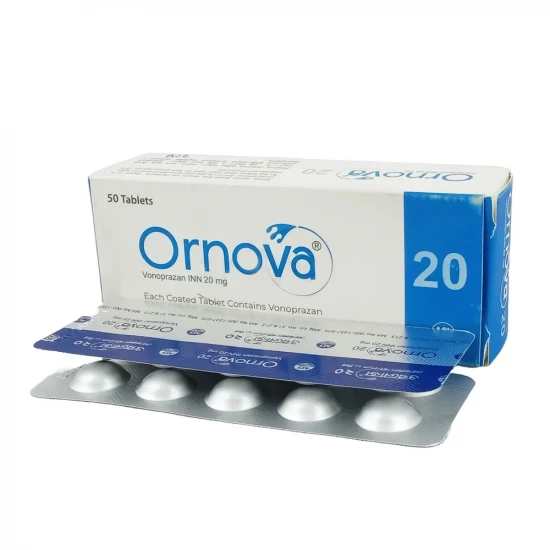
 Baby Mom
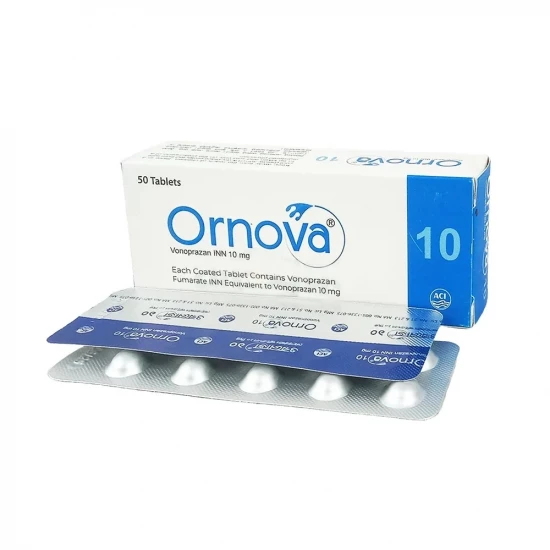

Manufacturer: ACI Limited
Generic: Vonoprazan
Type: Tablet
Pack Size: 10 Pcs

Hurry and get discounts on all Apple devices up to 20%
Sale_coupon_15
100.00৳ Original price was: 100.00৳ .95.00৳ Current price is: 95.00৳ .
Ornova is prescribed for the treatment of:
- Elderly: Use cautiously due to reduced hepatic/renal function.
- Children (<18 years): Not recommended (safety and efficacy unestablished).
- Renal impairment: No adjustment needed in mild–moderate impairment (eGFR 30–89 mL/min). Avoid in severe impairment (eGFR <30 mL/min).
- Hepatic impairment: Safe in mild impairment (Child-Pugh A). Avoid in moderate–severe impairment (Child-Pugh B or C).
Vonoprazan is a potassium-competitive acid blocker (P-CAB) that directly inhibits H+, K+-ATPase in a reversible and potassium-dependent manner, without the need for acid activation. Its strong basicity allows it to localize at the acid-secreting sites of gastric parietal cells, producing potent and long-lasting inhibition of gastric acid secretion. This results in effective protection against upper gastrointestinal mucosal damage.
As part of combination therapy for Helicobacter pylori eradication in conditions such as gastric/duodenal ulcer, gastric MALT lymphoma, idiopathic thrombocytopenic purpura, post-endoscopic resection of early gastric cancer, or H. pylori gastritis.
Baby Mom
No account yet?
Create an Account