


-5%
 Baby Mom
 Diabetic Care
 Health Devices
 Medicines
 Personal Care
 Sexual Wellbeing
 Vital Wellness
 Vitamins Supplements
 Women Care


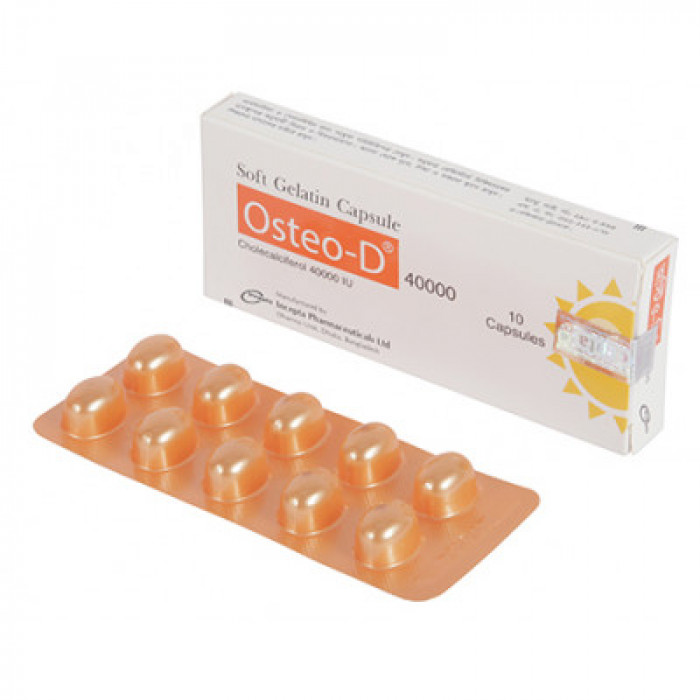
Manufacturer: Incepta Pharmaceuticals Ltd.
Type: Capsule
Pack Size: 10 Pcs

Hurry and get discounts on all Apple devices up to 20%
Sale_coupon_15
350.00৳ Original price was: 350.00৳ .332.50৳ Current price is: 332.50৳ .
Generic Name: Cholecalciferol (Vit. D3)
Incepta Pharmaceuticals Ltd.
Indications
Osteo-D 40000 is used to treat and prevent vitamin D3 insufficiency. It is also recommended as an adjuvant to specialized osteoporosis therapy in individuals with vitamin D3 insufficiency.
Pharmacology
Osteo-D 40000 aids in calcium and phosphorus absorption and reabsorption. Vitamin D3 is required for proper bone development and bone density maintenance. It also lessens the severity of bacterial infections, improves lung function, lowers the risk of cancer (breast, colorectal), and aids in the maintenance of normal insulin levels in type 2 diabetic patients.
Dosage & Administration
For capsule: Adults:
Treatment of Vitamin D3 deficiency: 40000 IU once weekly for 7 weeks. Doses for maintenance therapy is 1400-2000 IU/day. To confirm the target level of 25 hydroxyvitamin D, measurement of it should be determined 3-4 months after initiating the maintenance therapy.
Prevention of Vitamin D3 deficiency: 20000 IU every 4 weeks. Higher doses may be required in certain situations.
Addition to specific therapy for osteoporosis: 20000 IU once a month.
For capsule: Children (12-18 years):
Treatment of Vitamin D3 deficiency: 20000 IU once every 2 weeks for 6 weeks.
Prevention of Vitamin D3 deficiency: 20000 IU every 6 weeks.
For film-coated tablets: 1000 IU (1-2 tablets) daily, or as directed by a physician. Take the medicine with food or within 1 hour after a meal.
For oroflash or chewable tablets: 1000 IU to 2000 IU daily, or as directed by a physician. Take the medicine with food or within 1 hour after a meal. Place the tablet in the mouth swallow after chewing.
For Syrup:
For patients with risk of Cholecalciferol deficiency:
yr: 400 IU/ day (2 ml)
>1 Yr: 600 lU/ day (3 ml)
For Cholecalciferol deficient patients:
yr: 2000 IU/ day (+50000 IU/week ) for 6 weeks
-18 yrs: 2000 IU/ day for 6 weeks.
Injection: Prevention:
Infants receiving Vitamin D enriched milk: 1/2 ampoule (0.5ml) i.e. 1,00000 I.U. every 6 months.
Nursed infants or infants not receiving Vitamin D enriched milk or young children up to 5 years of age: 1 ampoule (1ml) i.e. 2,00000 I.U. every 6 months.
Adolescents: 1 ampoule (1ml) i.e. 2,00000 I.U. every 6 months during winter.
Pregnancy: 1/2 ampoule (0.5ml) i.e. 1,00000 I.U. from the 6th or 7th month of pregnancy.
Elderly: 1/2 ampoule (0.5ml) i.e. 1,00000 I.U. every 3 months. Digestive disorders, concomitant treatment with antiepileptics & other particular condition not described above; 1/2 ampoule (0.5ml) i.e. 1,00000 I.U. or 1 ampoule (1ml) i.e. 2,00000 I.U. every 3 or 6 months.
Injection: Vitamin D deficiency:
1 ampoule (1ml) i.e. 2,00000 I.U. which can be repeated 1 to 6 months later. Or, as directed by the registered physician.
Interaction
It has a negative interaction with phenytoin, barbiturates, glucocorticoids, some laxatives (such as liquid paraffin), actinomycin, and imidazole antifungal drugs.
Contraindications
It is not recommended for people who have a known intolerance to Vitamin D3.
Side Effects
Hypercalcaemia, hypercalciuria, skin rash, pruritus, urticaria, nausea, and stomach discomfort are the most common adverse effects.
Pregnancy & Lactation
Pregnancy dosages of up to 4000 IU have been demonstrated in studies to be safe. The recommended daily dosage for pregnant women is 400 IU; however, a larger dose may be necessary for women who are deemed Vitamin D3 deficient. During pregnancy, women should listen to their doctor’s recommendations because their needs may change based on the severity of their condition and their response to therapy.
Breast milk contains vitamin D3 and its metabolites. Overdoes in nursing mothers’ infants have not been reported; nevertheless, when giving more vitamin D3 to a breastfed kid, the practitioner should take the dose of any additional vitamin D3 given to the mother into account.
Precautions & Warnings
In individuals with poor renal function, it should be taken with care.
Storage Conditions
Maintain a temperature of less than 30o C and keep it away from light and moisture. Keep out of children’s reach.
Baby Mom
Diabetic Care
Health Devices
Medicines
Personal Care
Sexual Wellbeing
Vital Wellness
Vitamins Supplements
Women Care